
Is It Just Distraction?
Adult ADHD is often mistaken for simple distraction or laziness. Here’s what the research actually shows about how it shows up in daily adult life.
When most people picture ADHD, they picture a fidgety kid who can’t sit still in class. So when adults start wondering whether they might have it, the first objection is usually: “But I’m not hyperactive. I just… struggle.”
That struggle is exactly what adult ADHD tends to look like.
Hyperactivity Fades. The Rest Doesn’t.
Research following children with ADHD into adulthood shows a consistent pattern: the physical hyperactivity that’s so obvious in a seven-year-old usually fades by adolescence or adulthood. What’s often left behind is an inner restlessness — a nagging need to stay busy, a hard time relaxing, a mind that won’t settle.
Meanwhile, the harder-to-spot symptoms tend to stick around and quietly reshape adult life:
- Chronic trouble estimating how long things take, or how urgent something really is
- Starting tasks and drifting to something else before finishing
- Losing track of time so completely that “I’ll be there in five minutes” turns into forty-five
- Making decisions impulsively and regretting them almost immediately
- Struggling to sit through anything repetitive or tedious, even when it matters
None of this looks like the stereotype. It looks like missed deadlines, forgotten bills, a messy inbox, a string of half-finished projects, and a persistent, exhausting sense of being behind.
It’s Not About Being Unable to Pay Attention — It’s About Regulating It
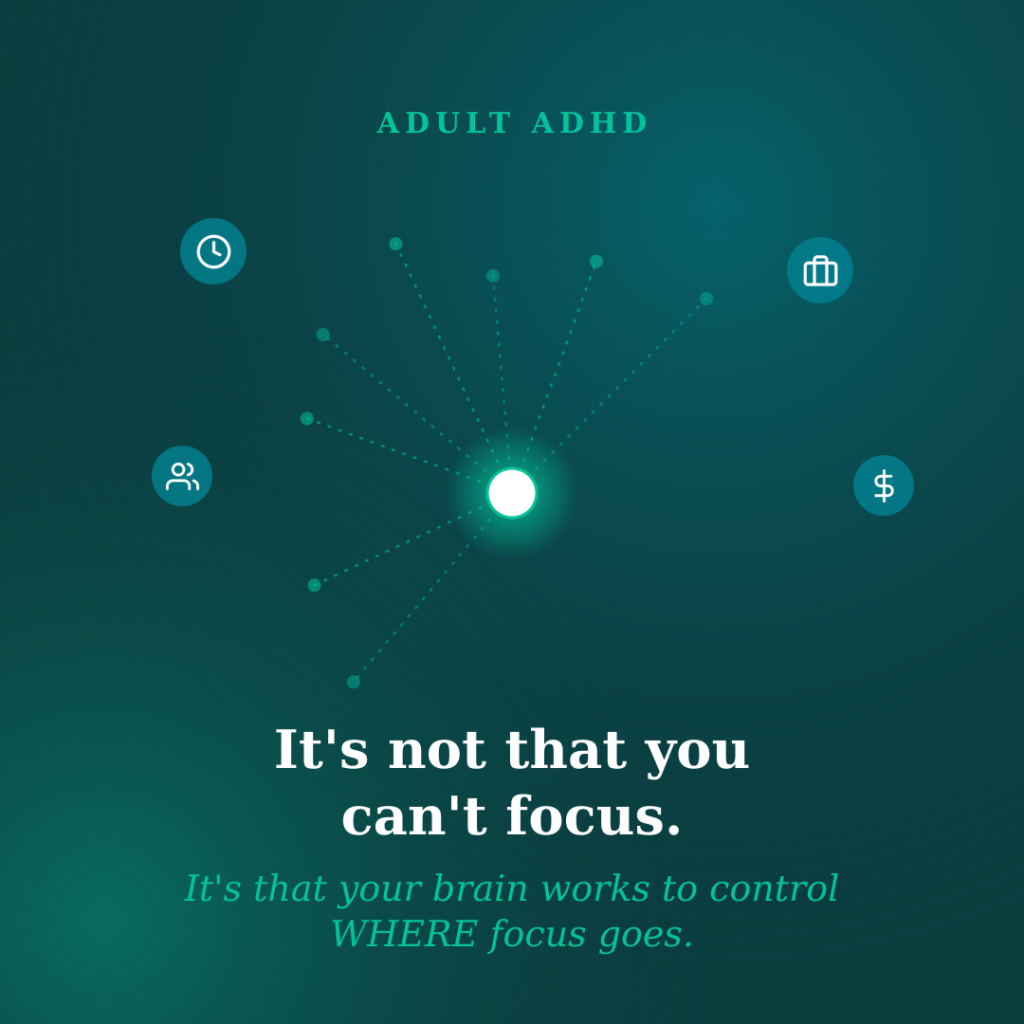
One of the more useful reframes from ADHD research is that the disorder isn’t really about a shortage of attention. People with ADHD can hyperfocus for hours on something genuinely interesting to them. The real issue is regulating attention — directing it toward what actually needs doing, especially when that thing is boring, effortful, or not immediately rewarding.
That distinction matters, because it explains a confusing contradiction many adults with ADHD notice in themselves: “I can focus for six hours on a hobby I love, so how can I possibly have an attention disorder?” The answer is that the disorder isn’t about capacity for attention — it’s about control over where that attention goes.
The Impact Adds Up Quietly
What separates ADHD from an ordinary bad week is how consistently these patterns show up, and how far back they go. Adults with significant, unmanaged ADHD symptoms often report struggling in a majority of the major areas of life — work, relationships, finances, health habits — not just one.
That’s a heavier toll than “I’m a little scattered.” Over months and years, it can look like:
- Frequent job changes or plateaued careers, not from lack of skill but from missed deadlines and follow-through
- Financial strain from impulsive spending or unpaid bills, despite decent income
- Relationship friction from interrupting, forgetting commitments, or reacting strongly in the moment
- A quiet, corrosive sense of “why can’t I just get it together like everyone else”
Why This Reframe Matters
If any of this sounds familiar, the point isn’t to self-diagnose from a blog post — only a qualified evaluation can do that. But it is worth loosening the old mental image of ADHD as “hyper kids who can’t sit still.” For a lot of adults, the real picture is quieter, more internal, and much easier to mistake for a character flaw than for what it actually is: a difference in how the brain manages attention, time, and impulse control.
Recognizing that difference is often the first step toward doing something about it.
This article draws on concepts and research discussed in Russell A. Barkley, PhD, “Taking Charge of Adult ADHD,” 2nd Edition (Guilford Press, 2022). It is intended for general educational purposes and is not a substitute for professional medical advice.